Monday, 29 June 2015

Old and New Fort Saskatchewan - The Fort itself

I visited 'The Fort' recently and went inside the newly built reconstruction of the original 'Fort on the Saskatchewan'. Some very interesting information - and you can feel a little like you were really there just after it was built (around 1875).

Here's a photo from one corner of the (newly built) Fort.

And here's a much earlier photo from almost the same location.


A few differences are obvious - plastic bins and the picnic tables - but it's surprisingly close overall. The old photo was taken after the 11ft walls (stockade) were taken down and the original guard house (low building towards the middle of that picture) had been removed. Plus a more recent building shows up (to the left rear...the ice house as I understand from my newspaper correspondent from The Sturgeon Creek Post - a publication I recommend reading if you want to keep track of what's going on in The Fort. The Sturgeon Creek Post is also the original name of the NWMP post that became Fort Sask). A few other things are 'close' - the chimneys in the men's quarters, the height of the flagpole, and some minor building differences - but these could also be due to the difference in timing. It's not clear when the old photo was taken - I got it from here.

Finally, a picture that I liked from the junior officers quarters - makes sense that there would be buffalo hides on the beds but they still had a big impact when we opened the door and first saw them!


Wednesday, 17 June 2015

#NoToTorontoOlympicBid number 2

I did a little reading of some of the more moderate articles on the economics of holding the Olympics, and the results seem to be summed up by the following (from the New York Times article "Does Hosting the Olympics Actually Pay Off?")

1. The Olympics won’t make a country rich.

2. They’re not even good for tourism.

3. But they will make its people happy.

I'd quibble with that last one, but it does seem that it makes a lot of sports fans in the country happy and as long as they're not asked to pay for it directly (like Montreal), they're OK with the false economics, etc.

I personally think it is a major waste of money and perpetuates the old boy's club of the IOC (see my last post) rather than focusing on furthering amateur sport and international cooperation. Hard to say whether it's worse to spend 10's of millions of dollars (or roughly $100M in the case of Chicago for the 2016 games) and lose, or to spend that money and 'win'.

So now I'll read some of the really negative reviews and see what they say!

Tuesday, 16 June 2015

#NoToTorontoOlympicBid

All I can do is point to this post and ask that the one or two readers of my blog also fight any attempts by various promoters of the Olympics to take our money.

(OK, I *can* do more - and both hope I don't need to and hope it will be useful - if needed)

Here's the image from Jim's blog that none of you probably want to see:

Monday, 18 May 2015

Our lilac bush's spring growth

Took this first photo in mid-April, just as our lilac bush was starting to get into its spring growth.


It was nice to see something green starting out after a long winter!

Then, as I was looking at the lilac recently I wondered what this particular branch looked like now. It was hard to tell exactly which one it was, but I believe that it is this one:


(May not be exactly the same branch, but the new growth looked pretty similar on all of them. The stems have also changed colour making it harder to match.)

The new growth above this junction now measures about 60cm - that's roughly 2ft for those not yet comfortable with this new-fangled metric stuff - and that's after only 1 month!


Sunday, 26 April 2015

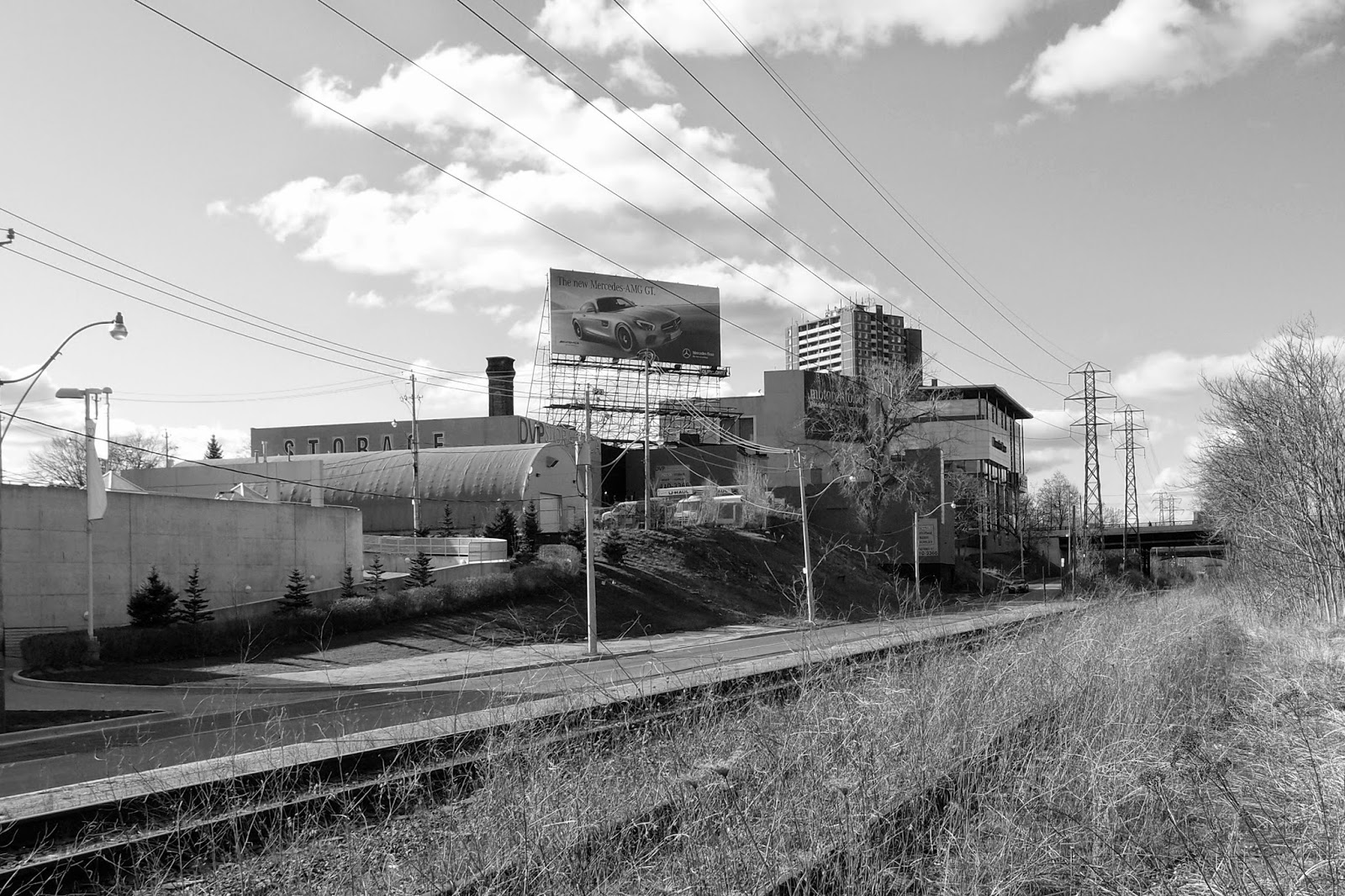
Old and New Toronto - Bayview Extension

Here's another 'old and new' comparison, looking at an old (1939) picture of the Royal Train (actually, the Royal pilot train) coming down the Don Valley. It would doubtless have gone right through the old Don Valley Station (recently updated blog entry - for those of you who follow this blog closely:-) ).


Lots of info in the fine print (you can click on the picture to see it much larger). For those who love trains, feel free to add info in the comments!

The reason this caught my eye was actually not the train, but the McColl Frontenac Oil Co. Limited building in the background on the left. I used to work for Imperial Oil, and when they bought Texaco Canada (formerly McColl Frontenac) it was always referred to as McColl Frontenac in any documents - some legal reasoning behind it I guess.

Anyway, now there is nothing much I could recognize except for the tracks and the Dundas Street bridge in the background at the far right. (Update from sharp-eyed reader - the pylons supporting the high-voltage lines also look to be the same).  Perhaps I should have waited until there was a streetcar on the bridge to have another similarity.


Some fun facts about McColl Frontenac:

Monday, 30 March 2015

The stubby

For all those who remember when beer came in a more practical shape (Quoting Wikipedia: "Some of the expected advantages of stubby bottles are: ease of handling; less breakage; lighter in weight; less storage space; and lower center of gravity").


And of course, not wanting to advertise any specific brand here, feel free to go to this Canadian Living article to look at other brands of stubby! Or to this site - http://www.stubby.ca/ - to find out more than you ever needed to know.

I was never that much of a beer drinker, but recently came across the above ad in an old scrapbook (don't ask me why I kept a piece of newspaper for 30+ years!).

But related to the stubby, I did drink Uncle Ben's pop (soda for any American readers) when I was a teenager - always cool to be holding a 'beer' bottle and walking around downtown!


Sunday, 15 March 2015

Are Rocket Booster Tests Slowing Down (or Speeding Up) the Rotation of the Earth?

Seeing the recent solid fuel rocket booster test got me to thinking about how much this might change the rotation of the Earth and thus the length of our day. What if it shortens the day?! It would be "Give us back our 11 days" all over again.

Anyway, The calculations seemed simple enough and follow for your viewing pleasure. (Note: if you find any major errors I'll just fix the blog and pretend it was right all along).

First, the change in angular momentum of the Earth is (F)(d)(t), where 'F' is the force of the rocket engine, 'd' is the distance from the axis of rotation, and 't' is time. For this blog I'm going to try and get the maximum effect, so we'll assume the engine is set parallel to the ground at the Equator (i.e. perpendicular to the radius), and facing East (or West).

The change in angular momentum = (moment of inertia)(delta omega) where 'omega' is the angular rotation of the Earth in Radians/sec.

For this calculation I'm going to assume a big rocket thruster produces roughly 10,000,000 Newtons force (the one linked to above may be slightly larger) and runs for a minute. The moment of inertia of the Earth is about 8 x 1037 kg m2, and the radius of the earth is roughly 6500 km. Putting this all together gives:

(8 x 1037 kg m2)(delta omega) = (10,000,000 kg m/s2)(6,500,000 m)(60 s)

Doing the math:
(delta omega) = 4.9 x 10⁻²³ rad/sec

Seems pretty big so far - after all 4.9 is no small number. But it would be useful to see just how much the x 10-23 affects it. (Side note, this reminds me of Avogadro's number which is 6.02 x 10²³)

So how much of an effect is this? How long will it take the Earth to slow down or speed up enough to add or subtract another second to the day?

1 second is 2(pi) / (24)(60)(60) radians
so 4.9 x 10⁻²³ (t) = 2(pi)/(24*60*60)
t=1.5 x 10¹⁸ seconds or roughly 4.7 x 10¹⁰ years (or approximately 10 times the age of the earth!)

Maybe not quite such a large effect!

20150316 Update: Seems that similar calculations have been done ('stopping the world' using Space Shuttle boosters) and the numbers are similar - with the caveat that it's only really valid if the Earth has no atmosphere! Oh well, it probably only works for spherical chickens in a vacuum (Big Bang Theory reference to the spherical cow metaphor).