Saturday, 12 August 2017

Old and New Toronto - Half Mile Bridge

I was interested to see this photo (below) in a book ("The Railways of Toronto" - The First Hundred Years by John Riddell) as it was taken relatively close to our house. So of course I wanted to see if I could find it today - and take a picture from approximately the same point. (Click to enlarge)


As it turns out, finding it was not difficult! It still exists today and is known as Half Mile Bridge. And it's not the original bridge in this location, but was built in 1928 to handle the heavier engines! (At least, as per this story - perhaps more interesting if you are into trains. Are you a ferroequinologist?

I could have got a 'closer to the original' photo if I had walked up the valley (or had hovered over the on-ramp to the Don Valley Parkway), but the picture below is from just below Chester Hill Lookout and is recognizably the same bridge. Maybe I can stop on the DVP one day and take a picture from the ground (at the bottom left of the picture below). I'm sure traffic won't mind ducking around me as I stop on the on-ramp there.


Some other pictures and stories (e.g. of walking over it) can also be found here. And for those who long for a little colour in these stories of yesteryear:


Wednesday, 21 June 2017

The Tulip Tree

I have posted various pictures of our tulip tree (or 'Liriodendron') on Facebook as it never ceases to amaze me:
  1. How fast it has grown
  2. How cool the leaves are
  3. How cool the flowers are
  4. And how much it changes year to year.
  5. (2018/3/10 update: see last picture)
So here are some random notes, including a short history of our tree.

We got it for our back yard back in Oct, 2007 from the 'LEAF' program, and at the time we were told that there were two types - one that grew to about 40ft (ours allegedly) and one that grew to about 60ft. (Check out the first link to see how these may be vast underestimates!)

Some maps of their distribution show them not being native to Ontario, but Ontario Trees&Shrubs (scroll to the bottom) shows it as being in various places thorughout the province.

Here's the new tree in 2007! (Click any picture to enlarge)


(Spoiler alert: The two trees to the left eventually get pushed out due to the shade). So, perhaps 8-10ft tall at this point. By Oct. 2009 it seems to have made itself at home:


Still no flowers - we thought perhaps the leaves looked a bit like tulips in cross-section, but that's not how it got its name! According to Wikipedia (and other references)
The Scientific Greek Liriodendron actually means "lily tree"
Perhaps the Greeks had never seen tulips?

Skip ahead a couple more years (Sept. 2011) and the construction next-door may have slowed it down a bit. However it's over 20ft tall by now. Still no flowers though.


Aug. 2014 and it's about 30ft tall...


...and the leaves are getting big.


(well, to a fly).

Lovely colour in the fall:


And a couple of  pictures by Jon (to help us forget how many leaves we actually have to rake):


Speaking of leaves, it does keep us busy in the fall.


It cuts a fine figure in winter and at night too. This picture was illuminated by me waving a flashlight around while the shutter was open.


And then finally, we saw (the late season shell of) a flower!


So what do these *really* look like? We were lucky enough to have a few in 2016, then a veritable flood in 2017. And they look like this:


The tree is now pushing 40ft tall. I expect it will suddenly stop growing, so as to not prove the 'LEAF' program wrong, since tulip trees are known to be very considerate of our feelings.

2018/3/10: Just when it seemed that there couldn't possibly be anything else to talk about for this tree :-) I saw the remains of multitudes of last year's 'tulips' in the tree. And this after 3 months of winter, rain, ice, etc! Gives a good idea of how many flowers there were last year, compared the the handful the previous year.

Wednesday, 7 December 2016

Chihuly at the ROM

Went to see the Chihuly exhibition at the ROM this past weekend and it had some pretty cool glass pieces. It wasn't something that captivated us for hours (more like 1/2 hr) but I thought it was still worth the visit.

I later read this Globe & Mail review and can agree with some of the sentiments. A lot of the 'Chihuly' name front and centre. I didn't realize he hadn't blown glass himself for nearly 40 years now due to an accident. (Seems to be somewhat accident-prone as he also lost an eye in an accident).

One of the most interesting things for me was the video showing some of the background behind what he has done, and how his approach changed over the years. He felt that it took at least 5 years to learn how to blow glass - not something you pick up in a weekend.

Here are a few of my phone pictures from our visit. (Click any photo to enlarge.)

A boat of glass.

Undersea garden?

Some cool-shaped bowl-like glass.

A glass tree
(This was one of my favourites and had an interesting visual effect. As you walked around it the tips of the 'branches' were always white, but the ones closest to you as you looked directly as the 'trunk' seemed blue. So it appeared that the branches were changing colour as you walked around it.)

Something to walk through.


Some small bowls
Fine lines and somewhat of a Native North American influence.

Sunday, 31 July 2016

Olympics (part 4)

It looks like Toronto has taken a breather on bidding for the Summer Olympics, but I still see interesting material every now and then that I'm sure you'd also like to know about.

Like this study that looked at the summer and winter Olympics from 1960 through 2014 and found that the summer Olympic Games went over budget by an average of 252% - which means you ADD 2 and a half times the budget cost, so a hypothetical $3B games would actually come in at about $10.5B(!)

As they call out in the article "Unfortunately, Olympics officials and hosts often misinform about the costs and cost overruns of the Games."

This analysis was done based on the estimates as of the time of the bid country being accepted. And on the actual games-related costs excluding infrastructure. As you might guess, in the years after the bid the budgets get adjusted many times so that the project can be 'shown' to come in close to budget. London was a prime example (in case anyone thought that came in anywhere near budget).

Let's go Rio! (As in, let's keep up this trend so it's less likely we'll ever bid on them again)


Friday, 10 June 2016

Art Deco R. C. Harris Water Treatment Plant

At the recent 'Doors Open Toronto' I visited the R. C. Harris Water Treatment Plant. Partly to complete my tours of the water cycle (having been through the Ashbridges Bay Wastewater Treatment Plant almost 30 years ago) and partly because it is a series of cool looking buildings!

It's an extremely basic process (bring in water from the Lake, let it settle, filter it, add some chlorine and flourine and pump it out again) but in some beautiful buildings. Here are some of my pictures (or take a look at a 'blog.to' link here). For a good 'guided tour' I liked the 'Torontoist' site - lots of interesting information. (Click any photo to enlarge)

Looking up to the filtration building.

One of the big front windows in the filtration building.

Rotunda in the filtration building.
(This was an interesting column. At the top on two sides the 'clock-like' dials show how full the water storage tanks used to backwash the filters are. One side is a clock. And one side shows something else about the water levels. Also an indicator light - red in the picture above - as to the readiness to clean the filters).


Control panel in the pump room.

Nice brass guardrails and chain.

The pump room

Part of the service building

And as an added bonus, you may have seen the plant in a movie or television show, since it often seems to have doubled as a jail, asylum, or some nasty corporation's HQ. See the RC Harris Wikipedia link from the first sentence for a list.

Saturday, 30 April 2016

Lilac budding

A budding young talent is captured here over a period of a couple of weeks. I thought it would be interesting to see how much our lilac bush (or Syringa) leaves grow early in spring.

Starting on April 9th

Then April 16th

Mid-week update April 19th

Then April 23rd

 And finally April 30th

Well, not really 'finally' I suppose, but I'm going to stop at this point. Perhaps I'll add an edit once it gets to its later summer self.

Saturday, 12 March 2016

Rolling Shutters

Did a little test today to see if my camera has a 'rolling shutter' approach. It's electronic, but I suppose it could still read the sensor a line at a time and give the same effect(?)

Anyway, having seen a number of photos of airplanes with 'bent' propellors (and a neat video) I thought I'd check out my camera (Olympus XZ-2).

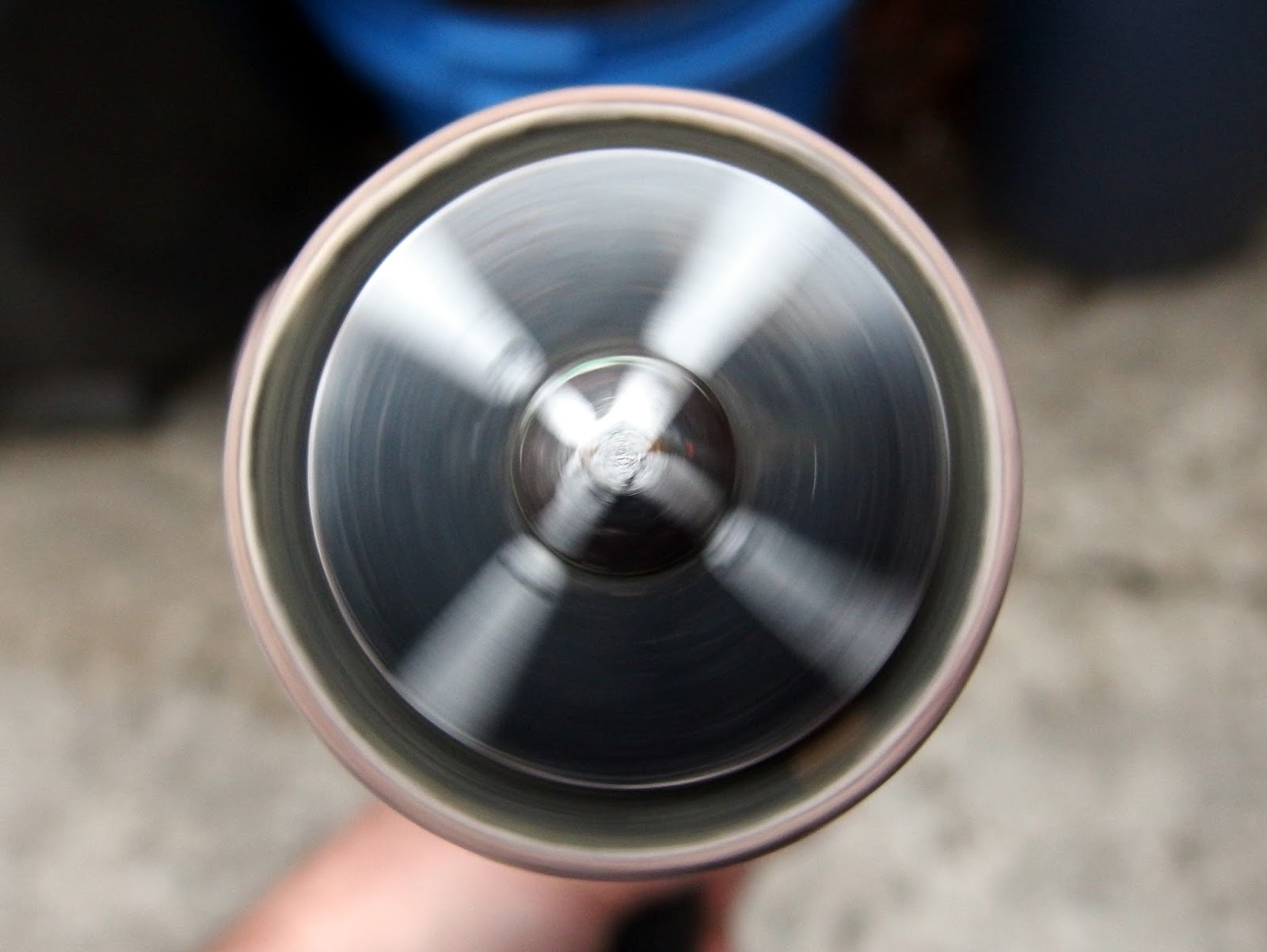
I made a little test rig by taking a cylindrical sanding attachment for a drill, and drawing a '+'  on the end of it. Then I attached it to the drill and ran it at about 1200 RPM (at least, that's what it was rated at).

Some quick math: 1200 RPM is 20 rev/sec. Thinking about an individual 'radius line' (the line I drew on the end of the cylinder from the center to the outside edge) - for it to cover 1/4 of the area of the end of the drill during the time of the shutter being open, the drill would need to turn 1/4 turn . This would be 1/20 sec divided by 4 or 1/80 sec.

So I started at a shutter speed of  1/250 sec (meaning that the blurred line should cover about 1/3 of 1/4 of the disk) and based on the photo below this looks about right.


Then, moving up to 1/500th, 1/1000th and 1/2000th of a second respectively:


Didn't notice much evidence of curving lines and thought it was important that you know :-)

(A pretty good explanation-type video is here, And of course Wikipedia has an article.)