Friday, 10 June 2016

Art Deco R. C. Harris Water Treatment Plant

At the recent 'Doors Open Toronto' I visited the R. C. Harris Water Treatment Plant. Partly to complete my tours of the water cycle (having been through the Ashbridges Bay Wastewater Treatment Plant almost 30 years ago) and partly because it is a series of cool looking buildings!

It's an extremely basic process (bring in water from the Lake, let it settle, filter it, add some chlorine and flourine and pump it out again) but in some beautiful buildings. Here are some of my pictures (or take a look at a 'blog.to' link here). For a good 'guided tour' I liked the 'Torontoist' site - lots of interesting information. (Click any photo to enlarge)

Looking up to the filtration building.

One of the big front windows in the filtration building.

Rotunda in the filtration building.
(This was an interesting column. At the top on two sides the 'clock-like' dials show how full the water storage tanks used to backwash the filters are. One side is a clock. And one side shows something else about the water levels. Also an indicator light - red in the picture above - as to the readiness to clean the filters).


Control panel in the pump room.

Nice brass guardrails and chain.

The pump room

Part of the service building

And as an added bonus, you may have seen the plant in a movie or television show, since it often seems to have doubled as a jail, asylum, or some nasty corporation's HQ. See the RC Harris Wikipedia link from the first sentence for a list.

Saturday, 30 April 2016

Lilac budding

A budding young talent is captured here over a period of a couple of weeks. I thought it would be interesting to see how much our lilac bush (or Syringa) leaves grow early in spring.

Starting on April 9th

Then April 16th

Mid-week update April 19th

Then April 23rd

 And finally April 30th

Well, not really 'finally' I suppose, but I'm going to stop at this point. Perhaps I'll add an edit once it gets to its later summer self.

Saturday, 12 March 2016

Rolling Shutters

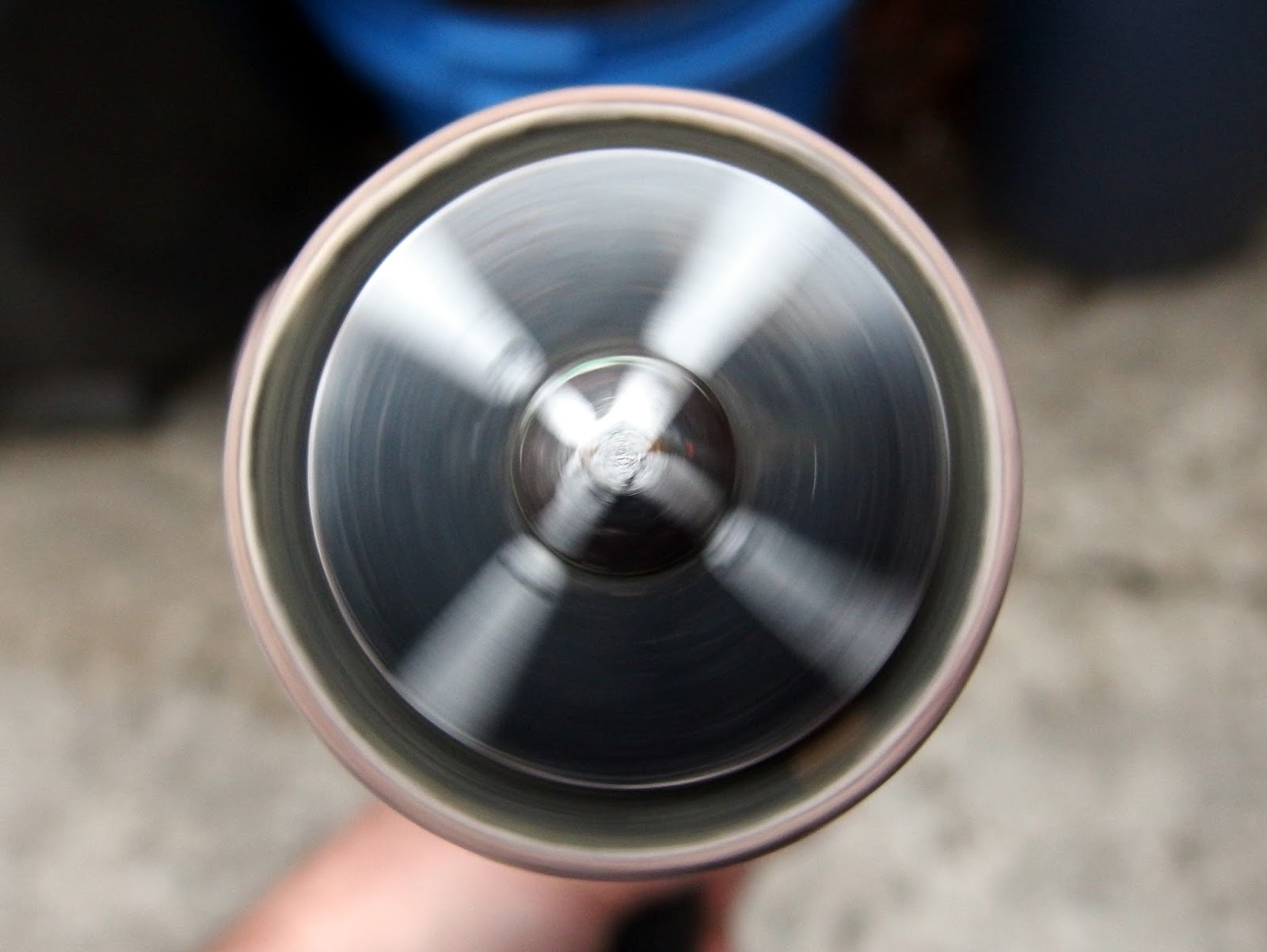
Did a little test today to see if my camera has a 'rolling shutter' approach. It's electronic, but I suppose it could still read the sensor a line at a time and give the same effect(?)

Anyway, having seen a number of photos of airplanes with 'bent' propellors (and a neat video) I thought I'd check out my camera (Olympus XZ-2).

I made a little test rig by taking a cylindrical sanding attachment for a drill, and drawing a '+'  on the end of it. Then I attached it to the drill and ran it at about 1200 RPM (at least, that's what it was rated at).

Some quick math: 1200 RPM is 20 rev/sec. Thinking about an individual 'radius line' (the line I drew on the end of the cylinder from the center to the outside edge) - for it to cover 1/4 of the area of the end of the drill during the time of the shutter being open, the drill would need to turn 1/4 turn . This would be 1/20 sec divided by 4 or 1/80 sec.

So I started at a shutter speed of  1/250 sec (meaning that the blurred line should cover about 1/3 of 1/4 of the disk) and based on the photo below this looks about right.


Then, moving up to 1/500th, 1/1000th and 1/2000th of a second respectively:


Didn't notice much evidence of curving lines and thought it was important that you know :-)

(A pretty good explanation-type video is here, And of course Wikipedia has an article.)

Saturday, 5 March 2016

Time for some cat photos

Since the internet is supposed to be full of cat stuff, I thought I should do my bit. Starting with a few pictures of our current cat (Holly) from when she was young (we got her at about 1 year old from the Toronto Humane Society).

(photo by Jon, along with 'some' editing he did)

(this was a month or so later - still quite small)

Then, about a year and a half later:
(perhaps her 'larger' phase')

And finally, about a month ago or so, with one of her favourite toys that has reinvigorated her!

And although she likes to explore the friendly confines of our back yard, she's not really an outdoor cat:


Monday, 7 December 2015

Old and New Toronto - Spadina Streetcars

Another postcard from the 'Flashbacks 2' series. "A streetcar on the Belt Line route (Spadina, King, Sherbourne, Bloor) rumbles by workmen engaged in road repair work, Spadina Avenue, c. 1899"


(Perhaps taken at the same time as my previous post?)

And now, with a similarly old streetcar in the picture:


(Similarly old meaning that in 116 years we can take another photo and compare).

Looking in the other direction, this photo (from 1927) already shows the Waverly Hotel (also in the picture above, just to the left of the '24hr' TTC sign). I was looking to see if the trough noted in the previous post was still there, but I think it would be hidden by the construction huts(?) on that side of the street.


Saturday, 5 December 2015

Old and New Toronto - Spadina Water Trough

Number seven in the series of old and new pictures of Toronto. The picture below is a scan of a 'Toronto Flashbacks 2' postcard noting that this is "Spadina Avenue and College Street, 1899. At one time there were dozens of these water troughs in the city for dogs, horses and (thanks to a cup on a chain) people to refresh themselves."


I had heard that there is at least one of these still around - in front of St. James Cathedral at Church and King. No idea if it is the *same* one, but I found it easily enough and it is being enjoyed mainly by pigeons now.


(I've also seen this online at http://urbantoronto.ca/forum/threads/miscellany-toronto-photographs-then-and-now.6947/page-252 and the photo quality is much better than my scan of the postcard). Also, there was another one at Bloor and Christie at one point. And many others of course, including one by the old police station on Pape Ave just north of Queen East.

As for the original location now?


Other than the building in the center (1 Spadina Circle) which used to be the site of Knox College, not many other buildings seem to have survived, though parts of the building between the Scott Mission (to the left of the picture) and the old Knox College building might still be there. Hard to see in the picture above (you'll need to click on it to get a larger view) but there is a three story building on the corner. This picture is zoomed in and from a slightly different angle - with the building circled in red.


So I walked up to get a picture of it, and the roof line looks somewhat like the original picture anyway. The rest has obviously been reworked.


Sunday, 29 November 2015

Newton's Cradle

Newton's cradle is a popular 'executive toy' that demonstrates conservation of momentum/energy. The steel (usually) balls that it is made with are quite elastic and do not lose much of the kinetic energy of the balls when they hit each other.


(For various things you can do with Newton's cradle, see this link and play the video. It also notes why Mythbusters' large-sized example didn't work as planned.)

When you pull back one steel ball and release it, it hits the other four and the last ball moves off with (almost) the same speed as the first one that hit the four. And interestingly, if you pull back two of the balls and release them, when those two hit the remaining three balls it is almost as if they 'know' that you pulled back two balls, since now the last two balls move off.

But how could it 'know' that you pulled back two balls? Of course, you can go through the equations (fairly straightforward) but the explanation at wikipedia is pretty good for a simplified situation:

"...when two balls are dropped to strike three stationary balls in a cradle, there is an unnoticed but crucial small distance between the two dropped balls and the action is as follows: The first moving ball that strikes the first stationary ball (the 2nd ball striking the 3rd ball) transfers all its velocity to the 3rd ball and stops. The 3rd ball then transfers the velocity to the 4th ball and stops, and then the 4th to the 5th ball. Right behind this sequence is the 1st ball transferring its velocity to the 2nd ball that had just been stopped, and the sequence repeats immediately and imperceptibly behind the first sequence, ejecting the 4th ball right behind the 5th ball with the same small separation that was between the two initial striking balls."

Seems like you only need a few micrometers separation for this to be true, so I'll have to look at that first photo a bit more closely!